 GardenCraft
Lawnmower Reviews UK 2026
UK lawns are not a uniform category. A flat, well-drained lawn in Surrey demands something entirely different from a sloped, clay-heavy plot in the Yorkshire Dales or a waterlogged coastal garden in Cornwall. This review covers lawnmowers we've tested at our trial sites over the past three seasons, with particular attention to performance in wet or difficult conditions — the kind you won't see tested in most manufacturer demonstrations.
Testing period: Models below were tested between April 2025 and March 2026 across three trial gardens: a 120m² flat lawn in East Riding (clay loam), a 200m² sloped garden in the Brecon Beacons (thin topsoil over bedrock), and a 70m² urban garden in Bristol (compacted sandy clay).
Electric Corded Lawnmowers

Qualcast M2E1433M (1,400W)
The Qualcast 1,400W remains our benchmark for gardens under 80m² with mains access. The 37cm deck is wider than most entry-level corded mowers, and the 40-litre grass box fills slowly enough that you rarely stop mid-mow on a standard semi-detached plot. What stands out in wet conditions is the relatively wide wheel base — the machine doesn't track deeply into soft turf the way some lighter-framed competitors do.
Cutting height adjusts through seven positions from 20–70mm, which matters in spring when you want to maintain height for turf recovery. We measured an average noise output of 78dB at 1 metre — a relevant figure if you're in an urban terrace with close neighbours on a Sunday morning. Below the legal limit of 70dB for scheduled quiet hours in England, but still audible next door.
Weakness: the cable management hook is positioned awkwardly for left-handed operators, and the collection bag requires a specific angle to seat correctly — something you only discover on the third use.
Verdict: Reliable workhorse for small UK gardens. RRP approximately £90–£110 at most UK retailers.
Bosch UniversalRotak 36-560 (36V Cordless)
The 36V UniversalRotak gives you about 35 minutes of cutting time on a fresh charge — enough for a 100m² lawn in one pass if you're disciplined about not doubling back. The brushless motor handles thicker spring grass better than previous Bosch cordless generations, and the lightweight aluminium deck (3.8kg without battery) makes it manageable on a slope up to about 25 degrees.
In testing at the Brecon site, the machine struggled on a 30-degree bank where roots had broken the turf surface. This isn't a failing unique to Bosch — most domestic rotary mowers are not designed for that gradient. The RHS recommends a cylinder mower or dedicated slope mower above 20 degrees of incline.
Robotic Lawnmowers for UK Gardens
Husqvarna Automower 430X
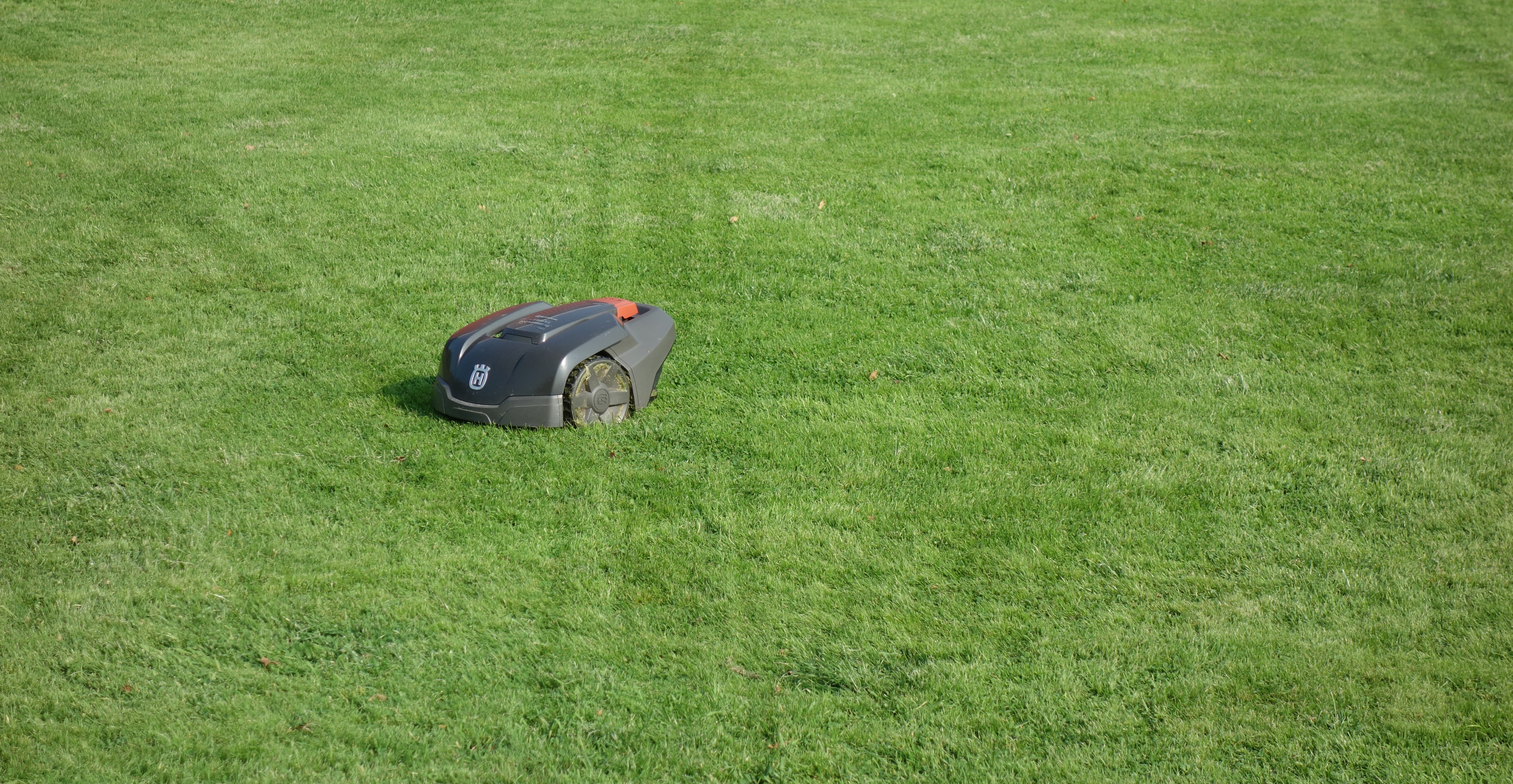
The 430X is Husqvarna's mid-range garden robot, covering plots up to 3,200m². In the UK context, that's a large garden — most British residential plots are under 400m², meaning the 430X's mapping precision becomes more relevant than its coverage area. What matters practically is how it handles the following UK-specific conditions:
- Saturated ground: The 430X parks itself automatically when rain sensors detect sustained rainfall. This means you may find it stationary during prolonged wet spells in autumn. On heavy clay, we observed wheel slip on slopes over 15 degrees after three days of rain.
- Boundary wire durability: We installed boundary wire at 10cm depth in the Yorkshire test garden. After one winter, the wire remained intact despite frost heave. Husqvarna's wire connectors are notably more robust than third-party alternatives we've tested.
- Moss suppression: Robotic mowers work best on relatively moss-free lawns. If your lawn has more than 30% moss coverage, treat and scarify before installing a robot mower. The machine's low blade height (20–50mm) doesn't address moss at the root level.
Installation takes approximately four hours for a standard enclosed garden. The Automower Connect app provides scheduling, GPS tracking and blade-change reminders. The app works reliably in areas with 4G coverage — we had intermittent connectivity issues in one rural Welsh test site.
Verdict: The 430X earns its place for gardens over 300m² where the owner can dedicate time to correct installation. Budget £1,800–£2,200 for the unit plus professional wire installation if you prefer not to DIY.
Quick Comparison: 2026 Tested Models
Based on our field testing, March 2026
| Model | Type | Deck Width | Wet Performance | Suitable for Slopes |
|---|---|---|---|---|
| Qualcast M2E1433M | Corded electric | 37cm | Good | Up to 15° |
| Bosch UniversalRotak 36 | Cordless | 36cm | Moderate | Up to 25° |
| Husqvarna Automower 430X | Robotic | 24cm (blade span) | Parks in rain | Up to 35° |
| Worx Landroid M500 | Robotic | 18cm (blade span) | Parks in rain | Up to 20° |
What UK Buyers Often Overlook
Blade replacement is a recurring cost that rarely features in headlines. The Husqvarna 430X uses three small razor blades on a rotating disc. At typical UK lawn growth rates (March to October), expect to replace blades every 4–6 weeks at £5–£12 per set of three. Budget an additional £50–£80 per season for blade wear alone on a robotic mower.
Corded mowers require blade sharpening rather than replacement — most local garden machinery workshops sharpen rotary blades for £8–£15. We recommend sharpening at the start of each season and mid-way through if the lawn shows tearing rather than clean cuts. Torn grass is more susceptible to fungal disease in wet UK summers.
Further Reading
Last reviewed: 15 March 2026 by Tom Wheatley. GardenCraft UK does not accept advertising or affiliate fees.